
How certified non-toxic activewear closes the last gap in your clean-living routine.
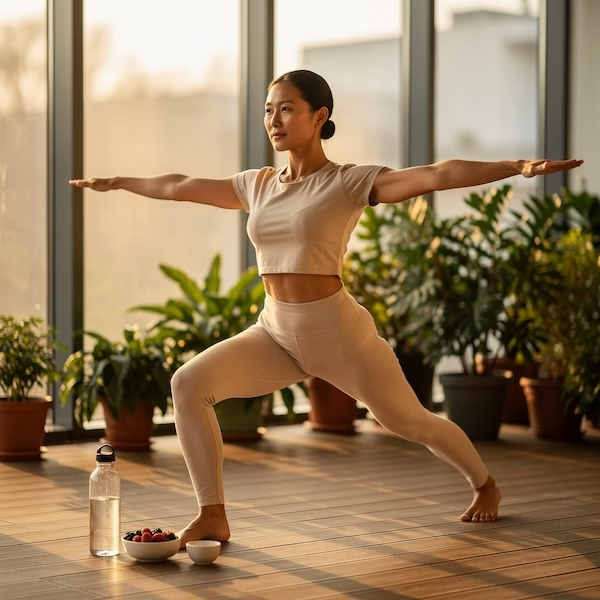
Picture this. Someone rolls out their yoga mat at 6 AM, sipping lemon water from a glass bottle. Breakfast was organic oats with berries. Skincare is clean, fragrance-free, and cruelty-certified. The meditation app is open. The intention is set.
Then they pull on a pair of sleek black leggings and begin a 90-minute hot yoga session. Those leggings are pressed against their skin, warming up, releasing microscopic compounds with every stretch and drop of sweat.
Here is the part almost nobody thinks about: most conventional activewear is made with chemicals most people would never willingly put on their bodies.
The Blind Spot in an Otherwise Perfect Routine
Health-conscious people have never had more information. They read labels. They research supplements. They ask whether produce is sprayed, whether packaging is BPA-free, whether deodorant contains aluminum.
But leggings? They get a pass. And it makes sense. Leggings are sold with words like performance, compression, and moisture-wicking. They look clean. They feel technical. The assumption is that if something is designed for exercise, it must be healthy by default.
That assumption is wrong.
Conventional leggings are usually made from polyester, nylon, or spandex. These synthetic fabrics are treated with per- and polyfluoroalkyl substances (PFAS) for water resistance, phthalates for flexibility, and sometimes formaldehyde to prevent wrinkles. These are not trace contaminants. They are intentional additives, baked into the fabric, sitting directly on the skin for hours at a time.
During a workout, the body heats up. Pores open. Sweat flows. That is precisely when fabric chemicals are most likely to migrate through the skin barrier. Research from the University of Birmingham found that PFAS can be absorbed dermally during exercise, especially when the skin is warm and wet.
So here is the contradiction: the same person who avoids plastic water bottles is wearing plastic pants, heated to body temperature, for hours every week.
And they have no idea.
Why This Matters Without the Fear
This is not about panic. The body is resilient. One workout in synthetic leggings will not cause harm.
But health is a long game. It is the sum of thousands of small decisions, repeated over years. The reason people choose organic food is not because one conventionally grown apple is poisonous. It is because chronic, low-level exposure to pesticides adds up.
The same logic applies here.
PFAS are known as forever chemicals because they do not break down in the body or the environment. They accumulate. Phthalates are endocrine disruptors, meaning they can interfere with hormone function. Formaldehyde is a known irritant. None of this is conspiracy theory. These are findings from the EPA, the CDC, and peer-reviewed toxicology journals.
The point is not to scare anyone. Most people simply do not know that activewear carries a chemical load. Once they do, the choice becomes obvious.
The Good News: A Better Option Already Exists
This is where the story flips.
There is a growing category of leggings made from certified organic cotton, hemp, TENCEL, and other plant-based fibers. These are not the stiff, baggy cotton pants from decades ago. Modern organic cotton leggings blend in 5-10% elastane for stretch, use low-impact dyes, and perform beautifully during yoga, pilates, weight training, and running.
The key certification to look for is GOTS — the Global Organic Textile Standard. GOTS-certified leggings guarantee that the cotton was grown without synthetic pesticides, that the manufacturing process restricts toxic chemicals, and that workers were treated ethically. It is the gold standard.
Other reliable markers include Oeko-Tex Standard 100, which tests for harmful substances, and brands that explicitly state they are PFAS-free and plastic-free.
What to Look For (The Simple Version)
Switching does not require becoming a textile expert. Three checks cover most of it:
- Check the fabric composition.
Look for organic cotton, hemp, or TENCEL as the main fiber. If the label reads 100% polyester or nylon, that is a red flag. A small percentage of elastane (5-10%) is normal and necessary for stretch, even in certified organic garments. - Look for GOTS or Oeko-Tex certification.
This should be listed on the product page or label. No certification means no verified guarantee. - Avoid greenwashing buzzwords without proof.
Words like eco-friendly and sustainable sound nice, but they are unregulated. A brand that is truly non-toxic will name its certifications specifically.
The Real Win: Better Performance, Not Just Better Values
Here is what makes this shift so satisfying: it does not require sacrifice.
Organic cotton leggings breathe better than synthetics. They do not trap odor the way polyester does. They feel softer against the skin. Many wearers report less irritation, fewer rashes, and less post-workout itch — especially those with sensitive skin.
Because organic cotton is a natural fiber, it wicks moisture differently. It absorbs sweat into the fiber and releases it gradually, rather than letting it pool on the surface. The result is a cooler, drier feel during long sessions.
And there is a deeper layer of alignment. The same person who composts, who chooses the glass bottle, who reads the fine print on supplements — that person can now extend their values to the clothing they sweat in. It closes a loop they probably did not realize was open.
The workout becomes cleaner in every sense. Not just the movement, but the materials surrounding it.
A Small Change With Real Momentum
Health is built on awareness. Every new piece of information is an invitation to adjust, not a judgment on the past.
Most people who discover this are not angry. They are relieved. Because the solution is simple, affordable, and already sitting in online shopping carts, waiting.
The next time someone reaches for leggings before a run, a hike, or a studio class, they can ask one quick question: are these working with my body, or against it?
The answer, for the first time, can be: with.
And that small shift — from unconscious exposure to intentional choice — is exactly what a health-conscious life is all about.