
If You Read Skincare Labels But Ignore Clothing Tags, This Is the Wake-Up Call Your Skin Needs
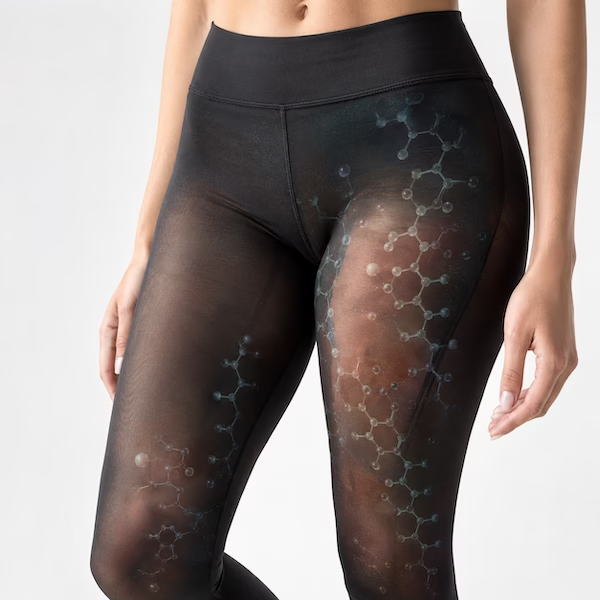
A new EU law just made certain activewear illegal. Not because of fit. Because of what is actually in the fabric.
You check labels for organic food. You read ingredients on skincare. When did you last ask what your leggings are made of?
That stretchy fabric pressing against your skin through yoga and your morning run? It might be loaded with PFHxA. That is a “forever chemical” Europe just prohibited in clothing starting October 2026. Unlike a restricted food dye, no law forces brands to tell you it is there.
What Is PFHxA – and Why Is It Hiding in Yoga Pants and Leggings?
PFHxA belongs to the PFAS family. Scientists call them “forever chemicals” because they do not break down. Not in nature. Not in your body.
The textile industry uses PFAS for water repellence, oil resistance, stain proofing, and durability. That “sweat-wicking” finish or “waterproof” membrane? It may be loaded with short-chain PFAS developed to replace the older PFOA chemicals that were phased out. The problem? These replacements are also persistent — and the EU restriction now targets both PFHxA itself and any substances likely to break down into it.
The new EU regulation — number 2024/2462 — does not mess around.
Starting October 10, 2026, any clothing, accessories, or footwear sold in the EU cannot contain more than 25 parts per billion of PFHxA and its salts. The limit for related substances that break down into PFHxA is 1,000 ppb, measured in homogeneous material. Products already on shelves before then are grandfathered in. Everything new after that? Clean or gone.
Phase two lands in October 2027, expanding the ban to all other textiles, leather, furs, and hides. This is not a suggestion. It is directly applicable law in all Member States. No national transposition needed.
Skin Is Your Largest Organ. Your Leggings Touch It for Hours Every Day.
The European Environment Agency names textiles as one of the biggest sources of PFAS pollution in Europe. Releases happen at every stage: manufacture, every wash, and disposal.
But here is the part most articles skip. The exposure route is direct and intimate. Fabric sits on your skin. You sweat. Your pores open. Those chemicals get an open door.
A Duke University study traced a massive contamination event in North Carolina straight back to a textile-finishing plant. Wastewater measured roughly 3 million times the EPA drinking-water limit. Regulators missed it for years because the chemicals showed up as solid nanoparticles. Not dissolved compounds labs normally test for.
If water near a factory carries that load, what does the finished garment still hold?
A peer-reviewed study in Environmental Science & Technology detected PFAS in all 72 stain-resistant children’s textile products tested. School uniforms carried significantly higher levels than other children’s items. The products closest to your skin, worn longest, absorbed most.
The Shocking Truth: No Law Forces Brands to Disclose PFAS on Clothing Labels
Here is what should stop you cold. There is currently no EU or US law that forces brands to declare PFAS on clothing. Federal US labeling rules cover fiber content, country of origin, and care instructions. They do not require a forever-chemical disclosure.
A brand can market “clean” activewear while the fabric carries residues. Eco Age, a sustainability consultancy, launched “The Forever Label” campaign in July 2026 demanding mandatory PFAS disclosure on hang tags and digital listings. Their argument is simple: the same basic principle already applies to allergens in food and ingredients in cosmetics. Brands already have this data in their supply chains. They just are not required to show it.
France already banned PFAS in cosmetics, textiles, and food packaging in 2026. Sweden starts its national consumer-product ban in 2028. California and New York banned intentionally added PFAS from most apparel starting January 2025, capping total organic fluorine at 100 parts per million. Colorado and Maine followed in 2026.
Regulators are finally treating clothing as a skin-contact product, not just a fashion item. Most shoppers still have no idea.
What Independent Testing Reveals About “Waterproof” and “Stain-Resistant” Labels
The NRDC tested 115 textile products in California and New York in 2025. Among rainwear, athletic pants, swimwear, and footwear, most showed PFAS levels under 10 ppm.
But here is the kicker.
Twenty of the twenty-four products that failed testing carried labels like “waterproof” or “stain resistant.”
Most clean products carried the exact same labels.
PFAS-free performance is possible. Some brands simply refuse to do the work. Even brands with published restricted-substance lists did not apply them across their full product range. A 2025 scorecard of ten children’s fashion brands showed an average chemical-safety score of just 35.3 out of 100.
The “performance” excuse is wearing thin. So is your trust in unverified marketing claims.
Patagonia Proved You Can Eliminate PFAS. It Just Took 15 Years.
Patagonia spent roughly fifteen years eliminating intentionally added PFAS. Every new style since Spring 2025 ships clean — the result of reworking membranes and finishes most competitors still rely on.
The trade-off? Their PFAS-free waterproof jackets need rewashing every 7 to 10 wears instead of thirty. A small price.
Other brands are now scrambling to catch up. Niber raised $11 million in August 2026 to scale PFAS-free membrane technology. Tera Mira is developing bio-based elastane from seaweed. Innovation is happening. But only because regulators and informed shoppers are pushing.
Vogue ran a headline in June 2026: “What it Takes to Make Less Toxic Performance Wear.” The conclusion? Performance and safety are no longer a trade-off. They are a baseline expectation.
How to Find Truly Non-Toxic Leggings and PFAS-Free Activewear: A 3-Step Checklist
Buying safe activewear should not require a chemistry degree. Use this checklist before your next purchase.
Step 1 — Look for Real Certifications, Not Marketing Buzzwords
Ignore vague terms like “eco-friendly,” “green,” or “conscious.” Look for verified third-party labels.
GOTS (Global Organic Textile Standard) covers post-harvest processing, human rights, social criteria, and ecological standards for certified organic fibers.
OEKO-TEX Standard 100 tests textiles against over 1,000 harmful substances — including REACH Annex XVII and XIV restricted compounds and the ECHA SVHC candidate list. It uses four product classes based on skin contact intensity:
- Class 1 (strictest): For babies and children up to 3 years.
- Class 2: Products with direct skin contact — this is where your leggings should land.
- Class 3: No direct skin contact.
- Class 4: Decoration materials.
If your leggings have an OEKO-TEX Class 2 label, you have independent proof the fabric has been tested for substances harmful to human health.
Step 2 — Ask Your Brand the One Question They Dread
If a brand claims “PFAS-free,” “non-toxic,” or “clean,” email them directly. Ask for test results or supplier compliance documentation.
Transparent brands answer. They have nothing to hide.
The brands that dodge the question with vague PR language? That is your answer. Move on.
Step 3 — Treat Your Leggings Like Skincare
The “clothing is skincare” trend is rising for a reason. You would not rub an unlabeled chemical serum on your legs and wear it for eight hours. Your leggings should not get a free pass just because the tag only lists polyester and elastane.
Treat fabric as a skin-contact product because that is exactly what it is.
The Bottom Line: Europe Drew the Line. The US Has Not. Your Skin Is the Battleground.
The EU set the limit at 25 ppb or go home. The US relies on a messy patchwork of state laws with no federal PFAS clothing standard. That means some shoppers are protected while others are not.
Without mandatory PFAS labeling on clothing, the only person guarding your skin is you.
Start with the drawer closest to your yoga mat. Read the tags. Look for GOTS or OEKO-TEX Standard 100, Class 2. If the brand will not say what is in the fabric, ask yourself why you are letting it touch your body.
Replace those leggings. Your skin will notice.